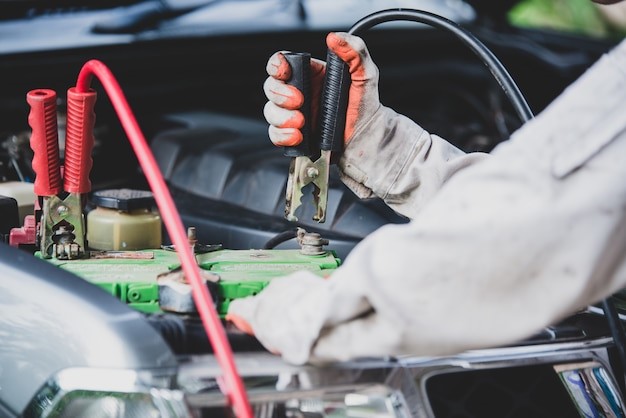
A dead car battery may strike any person; it may be a frosty morning, or it may be a day when you left your headlights on. When the car does not start, a jump start can always appear to be the fastest solution. However, in modern cars, it is not only the battery that is at stake. Newer automobiles possess complicated electrical networks, onboard computers and very delicate sensors which can easily break in the case of a jump start unless performed in a correct manner.
This is the reason it is not only necessary to know how to jump-start your car safely in order to get back to the road, but also to save valuable electronics in your car. This guide will discuss how to prevent damage to electronics during a jump start, safe jump start tips, and explain professional approaches to surge protection and correct polarity connections. All these tips can be used whether you provide your services or call a mobile roadside assistance technician, so that you can avoid expensive repairs, making the electrical systems of your car safe.
Why Modern Vehicles Need Extra Care During Jump Starts
Cars are no longer what they used to be. The wiring in older cars was plain and there were very few electronics, making jump-starting them generally easy. However, the present-day cars are based on sophisticated systems such as ECUs (Engine Control Units), infotainment displays, and dozens of sensors that regulate fuel injection to braking. These systems are flow-sensitive onboard electronics that can be influenced even by small spikes of voltage.
When you jump-start the car with the wrong polarity, there is a chance of a rush of electricity being thrown through the system. This may damage the ECU, blow fuses or it may even fry the important parts. This is the reason why professional roadside technicians incorporate voltage regulators, battery stabilizers and surge protectors so that the current is maintained at the same level during the process. Our close relationship with any connection will save you hundreds or even thousands of dollars in repairs.
What Causes Electrical Damage During a Jump Start
Electrical injury normally occurs in case of a sudden spike in voltage, improper connection of cables or reverse polarity. These problems result in the flow of electricity being in the opposite direction or at excessive voltage. A single second error is enough to damage sensitive circuits.
The second probable reason is that of hooking the cords directly to the negative side of the dead battery rather than hooking to a ground point of the jump start. This error may lead to sparks or a short circuit that may result in the failure of the ECU. Besides, cables should be removed slowly once the car starts, or reverse charge flow can occur, which provides an uncontrolled surge of charge flowing in your car’s systems. These risks should be understood so that you can take safer precautions when jump starting.
Understanding Vehicle ECU Protection
The ECU (Engine Control Unit) of your car is the brain of your car. It monitors and manages various systems engine timing to air-fuel ratios. When jump starting, there is a possibility that when the voltage spikes, it could reach the ECU and break its circuit. Depending on your car model, the cost of replacing an ECU may be only a few hundred dollars or even several thousand dollars.
To protect your ECU:
- Never jump before checking the battery terminals to see whether they are corroded or loosely connected.
- Do not attach or remove the cables when the ignition is on.
- Use a battery stabilizer or voltage regulator where possible – these devices absorb the superfluous current and eliminate spikes.
Technicians in a professional setting go the extra mile in verifying battery voltage on the first instance. This helps to prevent overloading of your ECU and other electronic modules by the boost.
Surge Protection During a Jump Start
Voltage surges occur when electrical current passes either too rapidly or asymmetrically between two batteries. This may occur when one of the batteries is significantly less powerful than the other or when the wires are connected in the reverse sequence. Surge protection on a jump makes the circulation of electricity stable and safe.
Surge protectors or regulated jump start systems are used by professionals to regulate this flow. These gadgets stabilize the voltage between two batteries and avoid spikes that may damage the computer systems of the car. In jump starting by hand, one should:
- Switch off all accessories (AC, radio, lights) and then connect the cables.
- Ensure that neither car is on and in park.
- Connect the cables correctly, that is, red (positive) to positive, then black (negative) to a grounding point, not the negative terminal of the battery.
The method minimizes the chances of sparks and avoids the destruction of fragile electronics onboard.
Correct Polarity Connection
One of the most frequent and most harmful jump start errors is reversing the polarity. Polarity implies the connection of the negative cables with the negative terminals and the positive cables with the positive terminals. When you confuse them, joining positive and negative, or vice versa, you are in danger of reversing the polarity, and your car will be ruined in a moment.
The following is a way of making sure that the connection between polarity is correct:
- A red cover or + sign is normally placed on the positive terminal.
- The negative terminal is denoted by the negative sign – and may be black.
- Check all connections twice before switching on the donor car.
Before going any further, professional technicians are always certain to test Polarity with a voltage meter. This is the easiest measure one can take to avoid reversing charge flow and it is also a measure to ensure that the two cars are not seriously damaged by electricity.
Finding the Right Grounding Point for a Jump Start
In jump starting, it is always better not to connect the negative lead to the negative terminal of the dead battery. Rather, ground on a safe point on the engine block or unpainted metal part at a distance from the battery. This assists in the prevention of sparks which may blow up battery gases and trigger a short.
Grounding serves two main purposes:
- Spark prevention: When you have contact with the battery, you eliminate the chances of an explosion by touching the ground.
- Electrical stability: A correct ground is necessary to provide a smoother current flow and help prevent surges that may damage the electronics in your car.
Find the assigned grounding bolts or brackets that are suggested in the manual of your vehicle. A lot of the contemporary automobiles have areas marked jump start grounding.
Avoiding Reverse Charge Flow
Reverse charge flow occurs when the electric current is flowing back to the donor vehicle or electrical system as a result of the recovered battery. This may lead to overheating, broken fuses or broken sensors. To avoid it:
- Apply surge-resistant and reversed flow cables.
- Make sure to switch off the donor vehicle and then unplug the cables.
- Always avoid unplugging cables as soon as the car is started, but allow one or two minutes to elapse before the car voltage levels stabilize.
Technicians mostly apply diagnostic tools to ensure that the right amount of current is flowing, after which cables are safely removed. By using this approach, the electronics of both vehicles are kept safe.
Protecting Sensitive Onboard Electronics
Modern automobiles are equipped with many flow-sensitive onboard electronic devices, such as ECUs, airbag modules, and infotainment systems. These are not made to accommodate unstable current or high voltage surges.
To protect them:
- Always switch off all the electronics, then make an attempt to jump.
- Do not use low-quality jumper cables or cheap portable jump packs.
- Wear jump gear with spike prevention capability of professional quality.
- Do not ever leave cables connected or disconnected to the ignition.
Caution will save your battery as well as save costly modules which otherwise would fail on a bad jump.
Voltage Spike Prevention and Safe Disconnection
Disconnection after start is also one of the last but most important steps. As your car starts, the alternator starts to produce power. You can get a voltage spike by removing the cables too rapidly, which passes a burst of energy through the electrical system of your car.
To prevent this:
- Allow the car some minutes running then disconnect.
- Unplug the cables in the same order in which they were plugged.
- Do not handle metal during the removal.
Professional jump start devices have voltage regulators that equalize the current as the car switches from external to internal power. Such a minor aspect contributes much to the safety of electronics.
Using a Battery Stabilizer During Jump Starts
A battery stabilizer is a kind of safety net for the power system of your car. It also regulates the voltage changes and cushions electronics when using a jump start, and after it. We have it in the practice of jump starting luxury and hybrid cars with sensitive electrical systems that the technicians employ stabilizers.
This is the reason why it is helpful to use a battery stabilizer:
- It eliminates the rapid rise in voltage which is capable of damaging the ECU.
- It provides a consistent flow of current when igniting.
- It secures the memory functions, radio codes and sensors onboard.
In case of the frequent use of jump starting your automobile, it is worth considering investing in a stabilizer or hiring professional roadside services that contain one.
Professional Jump Start Practices
There is no substitute for experience and the correct tools as far as jump starting safely is concerned. Strict jump start voltage regulator procedures are adhered to by professional roadside technicians. They not only check the batteries, but also use surge-protected clamps and make sure all connections are sound.
Professionals also bring diagnostic equipment to test your vehicle’s ECU protection, and this is to ensure that your system is stable before you apply power. The level of care prevents any damage, but a fast and reliable start is guaranteed too. When there have been warning lights or electrical problems after jumping the start button, there is no doubt that you did not use the correct technique to create a voltage imbalance, which is what an expert should have been trained on.
Tips for Safe Jump Starting
- Never jump start your vehicle without reading the vehicle manual.
- Have good jumper cables that are insulated.
- Ensure that the cables are not tangled or harmed.
- Do not allow the cable clamps to come in contact with each other.
- Take some wait times after the connection and before opening the car.
- To be on the safe side, call a mobile roadside assistance service in case of doubt.
Conclusion
Jump starting a car might seem easy; nevertheless, a single slip can render serious consequences of what happened to the electronics of your car. With the proper jump start procedure by adhering to the right jump start, proper use of surge protection and proper polarity connection, you will be able to save your car’s ECU, sensors and onboard systems. Waiting to be sure of your connections or allowing a bit of time to pass before voltage normalizes can be the difference between success and failure.
If you’re ever uncertain or want to ensure complete safety, it is best to call the experts. To explore more, visit All 4 One Transportation your trusted partner for professional roadside jump start services and safe vehicle recovery.
FAQs
Yes. Misplaced cable connections or voltage spikes will damage your ECU and other wiring. The proper jump start practice should always be applied.
Use a metal surface unpainted on the engine or chassis, and not the negative terminal of the battery.
Always use a surge protector or battery stabilizer and never turn on both cars and then connect the cables.
Switching polarity may lead to intense electrical damage, fuses, or stomp out your ECU.
No less than one or two minutes, yes. This acts to stabilize the voltage and then disconnects you.
Yes. Vehicle electronics are sensitive and technicians protect them with voltage controllers, surge suppressors, and stabilizers.
Disconnect accessories, disconnect cables in reverse order and do not touch any metal surfaces when disconnecting.